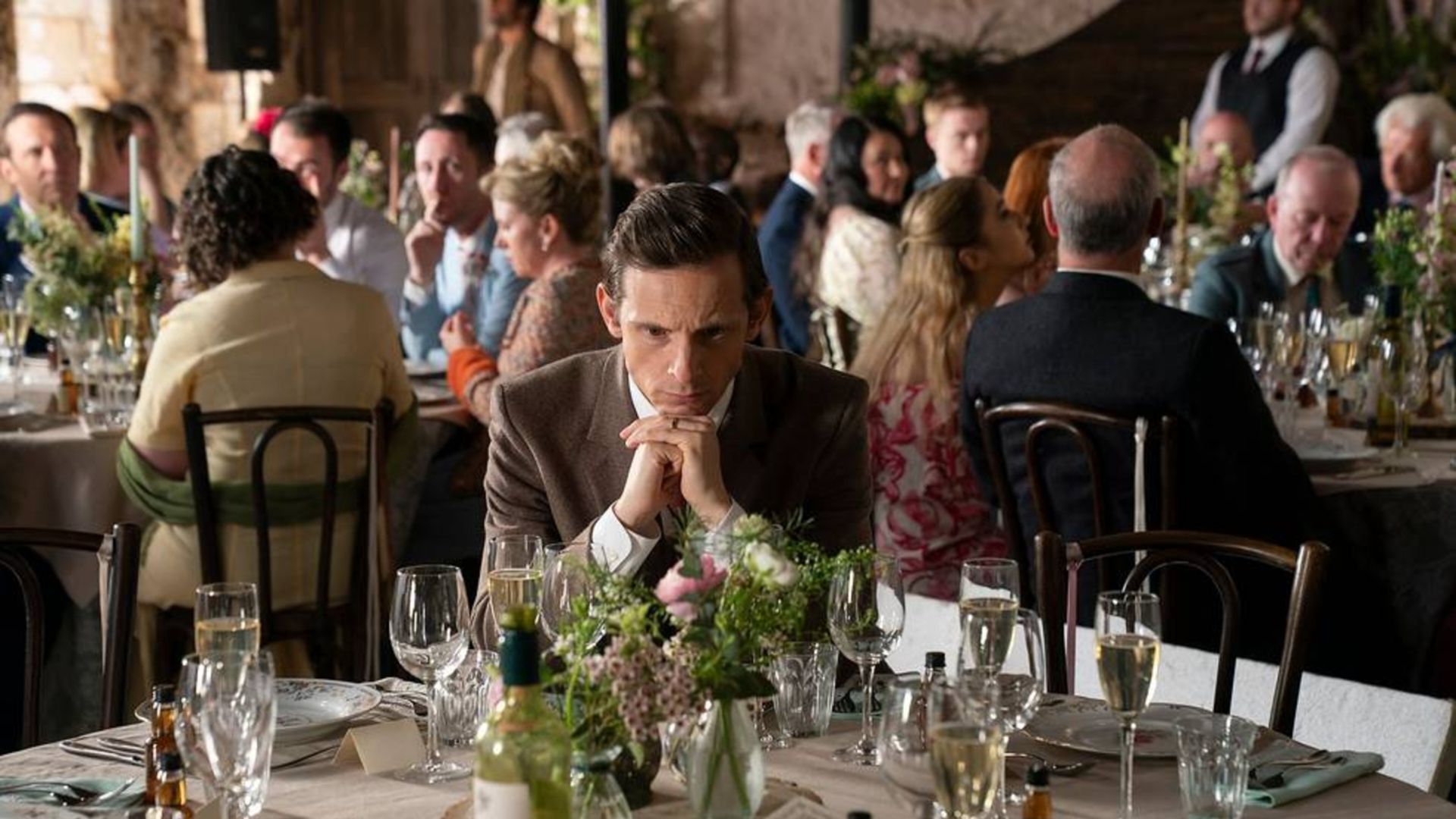
この記事にはハーフマンの最終話のネタバレが含まれていることに注意してください。ナイル・ケネディはハーフマンで初めて観客に披露されましたが、ジェイミー・ベルの演技がこの悲痛なキャラクターの物語を美しく締めくくりました。
リチャード・ガッドのシリーズハーフマンは数十年に及び、複雑な関係を共有するナイルとルーベンの物語を語ります。彼らは「別の恋人の兄弟」と表現されています。この番組では、男らしさ、隠された感情、困難な家族関係などのテーマが描かれています。フラッシュバックを通して語られる物語は、ナイルとアルビー(ルーベンの過去のパートナー)の結婚式と、登場人物たちの困難な子供時代と波乱に満ちた大人の人生の間を飛び越えます。
ナイルとルーベンが刑務所から出所した後に再会するナイルとルーベンの間の暴力的な衝突で、ついに対立が爆発する。彼らは物理的に戦い、ルーベンは最終的にナイルを窒息させますが、ナイルはなんとか最初にルーベンの脇腹を刺すことに成功しました。ルーベンがエピソード4で死亡したことはすでに知られていましたが、ナイルの死は、すでに暗く困難な物語における驚くべき展開でした。
私は最近、番組の 6 つのエピソードを通してナイルの物語についてロバートソンと話しました。特に最後の 3 つのエピソードで、物語が展開するにつれて、キャラクターに対する彼の理解が実際にどのように変化したかを聞くのは魅力的でした。彼は、その結末がナイルにとって、そして番組全体にとって何を意味するのかについて、非常に思慮深い洞察をいくつか共有してくれました。彼の視点を得ることができて本当に良かったです。

ScreenRant は、『Half Man』に対する驚くべき反応と、そのような肯定的な反応を見たことがどのようなものなのかについて尋ねました。
番組に対する反応を見ると驚くべきものでした。 Instagram で人々が私に連絡してくるようになり、オンラインでの話題を追っています。最初はコメントを読まないようにしていましたが、これほど人気があり、期待も高い番組なので、興味を持たずにはいられないでしょう。ありがたいことに、反応は圧倒的に好意的です。すべてのこと、特に知らない視聴者からのメッセージすべてに追いつくのに少し苦労しました。最初は全員に返信しようとしました – 時間を割いて連絡してくれた人には感謝の意を表したかった – しかし、それは現実的ではないことにすぐに気づきました。あまりにも多すぎるので、自分の時間と心の平安を守る必要がありました。
SR: 特にこのようなヘビーなショーでも、そのような反応は新鮮だったと確信しています。
視聴者がナイルとルーベンの複雑な関係に共感してくれているのを見るのは素晴らしいことです。それはまさに私たちが目指していたものです。それは押し引きのダイナミックさです。時には彼らが前進することを応援し、また時には彼らがつながりを維持することに全力を注ぐこともあります。オンラインでそのような反応が見られたので、本当にやりがいを感じています。
特に第 3 話では、物語の変化が本当に魅力的です。その後、焦点はジェイミー・ベルとリチャード・ガッドに移ります。俳優としてその変化を乗り切るのはどんな感じだったのか、そしてキャラクターたちが新しい方向に成長していくのを見ながら、あなた自身のプロセスについて何を発見したのか気になりました。
ロバートソン: 私は人間としての自分について、本当に多くのことを学びました。
これについては前にも話しましたが、リチャードが生み出すような内面の混乱を抱えたキャラクターを演じることで、ドラマが終わった後、自分の人生について本当に考えさせられました。それは、私が避けていたこと、恥の感情、繰り返し続けていた不健康なパターンを特定するのに役立ちました。それは本当に変革的な経験でした。正直に言って、私は今でもそのような個人的な考察のいくつかに取り組んでいます。
ご存知のとおり、このプロジェクトに参加したことで、俳優として私は本当に変わりました。私はほぼ 3 か月間継続的に作業し、毎日いくつかのシーンを実行したので、毎日毎日何か新しいことを学んでいました。正直に言うと、全体的により良いパフォーマンスができたと感じています。ただし、それは大きな教訓ではありませんでした。むしろ、その過程でたくさんの小さなことを吸収するようなもので、当時は自分が何を学んでいるのか完全には理解していませんでした!
また、ディレクターの Alex Brodski からも多くのことを学びました。彼女は、本物で説得力のあるものを感じる素晴らしい感覚を持っています。彼女はシーンを面白くするものを常に探していました、そしてそれは私が本当に心に留めていることです。彼女と一緒に仕事をすることで、私のアプローチが変わりました。今では、単に「良い」と思うものではなく、興味をそそるものや、さらに探究する価値のあるものを見つけることに重点を置いています。
エピソード 3 の終わり方がとても好きです。それは聴衆に力強く未解決の印象を残します。法廷シーンの後にちょっとした締めくくりとなるシーンも撮影しましたが、最終カットにならなくてよかったです。その激しい瞬間に物事を放置することは、小さな解決策を提示するよりもはるかに影響力があります。
I was really struck by something Joanna says in the third episode – the line, “Snakes can shed their skin, but they always crawl on their bellies.” It feels important to the whole series. Considering how Niall and Ruben constantly seem to be hindering each other’s progress, I’m wondering what the show is trying to say about whether people – or these two specifically – are truly capable of change?
What I admire most about Richard’s writing is that his characters are never simply good or bad. He consistently explores the idea that everyone is capable of making mistakes and even being self-destructive, recognizing that making mistakes is just part of being human.
I have a feeling this question will stay with me for a while, something I’ll suddenly realize later. Honestly, I’m not sure what the answer is. It’s hard to look away from their relationship because you can see how much they need each other, and it feels like they’re overly reliant on one another. I think things might have been easier for them if they hadn’t met, but they’re clearly connected by a strong bond they can’t break. It’s possible that being apart would have led to a smoother path for both of them.
The show creates a lot of uncertainty – it’s like something could happen one way or another, similar to the Schrödinger’s cat thought experiment. We definitely see this with Niall’s story and how things ultimately turn out for him; it almost feels like his fate and someone else’s could have been swapped. I was really interested in how you, as an actor, processed all of that. Did you read all the scripts for the season at once, or did you watch the episodes as they aired? What were your thoughts on how Niall’s story unfolded?
I hadn’t read the scripts for episodes four through six, but I had a general sense of the plot. I didn’t need to know all the details, and I intentionally avoided them. I only watched those episodes for the first time about a week or two before the show aired. It wasn’t long before the release date. Surprisingly, when I finished watching, I was a bit unsure how I felt. It’s a character I played, but now another actor is portraying him, and the character has changed significantly with the passage of time. As the story progressed, I actually started to feel less sympathetic towards Niall. His self-destructive behavior became so extreme that I lost some of my… not love for him, but definitely my sympathy, which was a really interesting realization, and honestly, how I truly felt.
SR: Yeah, like “What the hell are you doing?”
Yeah, let’s pause there for a moment. The dynamic between Ruben and Niall is constantly shifting, especially in the first three episodes. They go back and forth, each needing the other at different times – it’s like a seesaw. But starting in episode four, that really changes. One of them starts thriving while the other really struggles, and honestly, I was pretty shocked watching episodes four through six.
Did learning more about Niall throughout the first three episodes change your understanding of him? Were there any actions by Jamie or plot twists that made you see his earlier behavior in a completely new light?
Robertson admitted he wondered if the character’s increasingly self-destructive behavior in the final episodes made it hard to see him as a good person.
While playing the first three episodes, I really felt that Niall was fundamentally a good person, despite being capable of making mistakes – mistakes that seemed to stem from insecurity, shame, or a desire for self-protection. However, as I continued to episodes four through six, I started to question that initial impression and wonder if he wasn’t who I originally thought he was.
It feels like a turning point at the end of episode three when the character almost lies in court, but ultimately doesn’t. Then, he’s threatened by Ruben, someone he cares about deeply. I tend to agree with your point of view on that.
I saw the third season as a story about a character making the right moral choice. He ultimately does the right thing by telling the truth, which felt like a positive resolution. I finished the season believing he was a fundamentally good person. Because of that, I naively expected seasons four, five, and six to continue that positive trajectory, but things definitely changed, and not for the better. It was a surprise, considering where I thought his story was headed.
We’re hoping for a happy ending for Niall, maybe seeing him find happiness with Albie through marriage. There’s been discussion about why Niall marries Albie, and then later reconnects with Jamie. It makes you wonder if Niall’s relationship with Albie is partly driven by guilt over the trial, like he’s trying to show Ruben that telling the truth was the right thing to do, and that it ultimately led to something good.
That’s a really interesting idea. There’s definitely a strong connection between those two characters, both when they first meet and later on, and it makes you want to see them succeed. It’s fascinating to consider how much their reconnection might be driven by guilt. It’s entirely possible, because as people, we often don’t fully understand our own motivations. We tend to believe we know why we do things, but the real reasons can often be quite different, even the opposite of what we think.
You know, I was really struck by that ending – it wasn’t a feel-good moment, that’s for sure. Both Niall and Ruben really paid the price, and honestly, it felt right, like a proper tragedy. I was curious, after seeing how it all played out, if the director talked with Richard about that specific ending. Did they feel like this was the only place those characters could end up, or what was their take on it? It really got me thinking about their journeys.
I haven’t talked to him yet, and haven’t had the opportunity to discuss what happened. It almost feels right that their relationship leads to both of their downfalls – that it ends in destruction. It really highlights how some connections can be incredibly damaging. I would have preferred a happier outcome, but I honestly didn’t know how things would unfold. I was completely in the dark. The reveal at the end of episode five, that Ruben doesn’t survive, really emphasizes how things can escalate in a toxic relationship and that there are always consequences to your actions.
What do you think?
I felt like the story worked well. It’s really about how these characters keep hurting each other, and I wanted to see Niall find some happiness. But, even with that, the ending didn’t feel forced or undeserved.
I really hoped for a satisfying conclusion, where everything worked out for the characters. That’s what the entire series felt like – a promise that things would eventually be okay. But just when you thought they had it figured out, something always went wrong.
SR: They get too comfortable in a way [and] it blows up again.
Absolutely. It’s completely spiraled out of control. It’s like constantly putting out a fire – just when you think it’s extinguished, a small spark reignites and quickly grows bigger and bigger.
Weddings are naturally dramatic events, full of people and emotion. That makes them a fitting place for a story to reach its climax or conclusion.
SR: Yeah. No, absolutely. Absolutely. No, I was blown away when I finished it.
I watched episodes four, five, and six back-to-back, and it was a bit overwhelming to process everything afterward.
It’s been great to see so many people online talking about how excited they are for each new episode. I especially liked how the first episode was released, giving everyone time to really think about it and process what happened. It’s been nice letting the audience experience it and then coming back to them when they’re fully engaged.
This is sparking a much more engaging discussion. I have one broader question, which ties in nicely with what we’ve been talking about. Late last year or earlier this year in the UK, a six-part queer show called ‘Heated Rivalry’ came out. Some people have jokingly referred to ‘Half Man’ as ‘Heated Rivalry’ for a more intense audience. It’s led to conversations about the different sides of queer storytelling – specifically, exploring repressed sexuality and shame, and how we address those themes. I’m curious to hear your thoughts on this, considering the recent increase in shows depicting gay men grappling with their sexuality within a larger cultural context.
You know, I haven’t actually seen “Heated Rivalry” yet. Honestly, I feel like I don’t know enough about the full context to really comment. What I do know is my own experience playing Niall in “Half Man” and what I brought to that role. Specifically, growing up in the west of Scotland really shaped my understanding. It wasn’t the present day, but even as a kid and teenager, being called gay was the worst possible insult you could receive at school. There was so much shame attached to it, and people really carried that with them. So when I approached playing Niall, I knew it was crucial to explore how someone internalizes that shame, how deeply those walls get built up, and how it affects them.
Considering all of that, the film Half Man really highlights why it’s important to continue sharing these kinds of stories and looking at them from different angles. Everyone’s experience is unique, and Heated Rivalry, being set in Canada, adds another layer to that.
As a fan, I really love that the show is tackling these kinds of stories, and it’s awesome they’re setting them in such different places. We’ve got one in Canada, focusing on the world of sports, and then another in Western Scotland – totally different experiences! It’s great to see how the location impacts the story, because it really does change things. It means we don’t get just one simple story; instead, we get something richer and more complex, reflecting all the different layers of life.
I really cared about that aspect of the show and felt strongly about it. Our show has many layers, and Niall’s internal struggles are central to the story. He grapples with his identity and sexuality, and how that impacts his life. If he’d had more support growing up, things might have turned out differently for him.
All episodes of Half Man are now streaming on HBO Max.
- USD JPY 予想・見通し・の予想
- CNY JPY 予想・見通し・の予想
- EUR JPY 予想・見通し・の予想
- スーパーマリオギャラクシー映画の後、5人の最大のマリオキャラクターがまだ行方不明
- 8部構成の「ゲーム・オブ・スローンズ・ミーツ・ウォーキング・デッド」シリーズはどちらよりも良い結末を迎える
- ウェット・ホット・アメリカン・サマー、ほとんどの人が知らないコミックのスピンオフが誕生
- トビー・マグワイアの元は娘の大学のドロップオフで感情的になります
- JPY KRW 予想・見通し・の予想
- Tougen ankiエピソード6リリース日、時刻、見る場所
- チャーリー・シーンは、燃えるような回想録でブルック・ミューラーとデニス・リチャーズと彼の運命の結婚を叩きつけます
2026-05-29 05:30